FREE SHIPPING ON ORDERS OVER £70

Calf Compression Sleeves: Your Complete Guide to Benefits and Usage

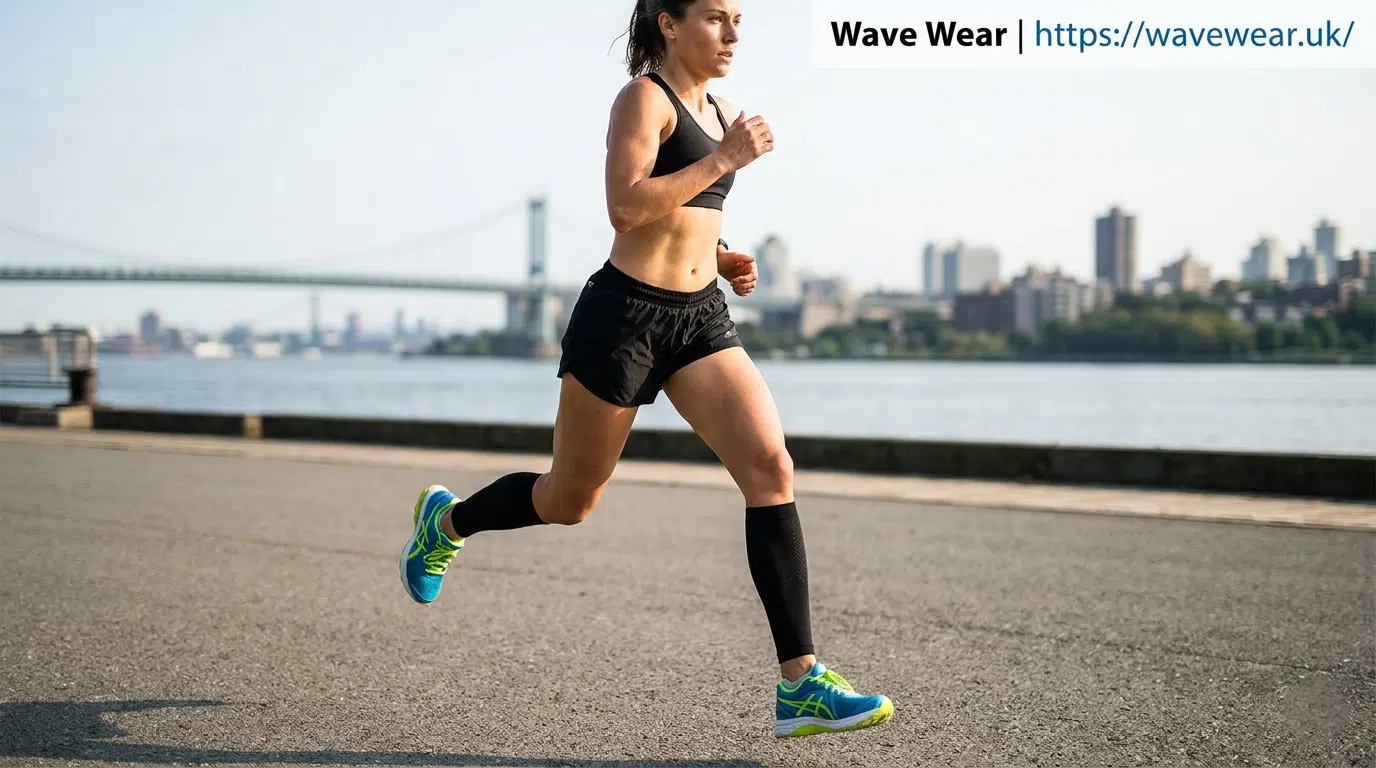
Calf compression sleeves are form-fitting, tubular garments worn on the lower leg – from just above the ankle to just below the knee – that apply calibrated graduated pressure to the calf muscles and surrounding soft tissue.
In plain terms, they squeeze the lower leg in a carefully designed pattern: firmest at the ankle, gradually looser toward the knee. That single structural detail drives every benefit they deliver.
What Well-Designed Compression Sleeves for Legs Do:
- Improve blood circulation back toward the heart by assisting venous return.
- Reduce muscle vibration and micro-damage during running, hiking, and impact sport.
- Speed up post-exercise recovery by clearing lactic acid and metabolic waste from calf tissue.
- Prevent lower-leg swelling during prolonged sitting, standing, long-haul flights, and shift work.
- Support the calf muscles and tendons during activity to reduce fatigue and injury risk.
They are not exclusively an athlete’s tool. Runners, cyclists, nurses, pregnant women, desk workers, frequent flyers, and anyone whose legs feel heavy and tired by end of day can benefit – provided the sleeve fits correctly and the compression level matches the purpose.
What This Guide Covers
This is a complete, no-fluff guide to calf compression sleeves – covering everything from the science behind the squeeze to how to size, wear, and care for them correctly.
Here is what you will find inside:
- How calf compression sleeves work at the biomechanical level, including a benefit almost no other guide mentions.
- Seven evidence-backed benefits, each matched to the specific people who gain most from them.
- A plain-English breakdown of compression levels (mmHg) with a straightforward recommendation by use case.
- A step-by-step sizing and measuring guide.
- The real difference between compression sleeves and compression socks, with a simple decision framework.
- Five widely believed myths, debunked with published research.
- Concise answers to the most searched Google People Also Ask questions on this topic.
How Calf Compression Sleeves Work: The Biomechanics Behind the Squeeze
Before choosing a calf compression sleeve, it helps to understand what it is actually doing to your body. The physiology is not complicated – it is straightforward mechanics that explains why compression works reliably for some purposes and less so for others.
Graduated Compression and Venous Return
Your heart pumps oxygenated blood down to your legs without much effort – gravity assists the process. The return journey is considerably harder.
Getting deoxygenated blood back up from the calves to the heart requires three things to work simultaneously:
- Muscle contractions – the calf muscle pump squeezes blood upward with every step.
- Functioning venous valves – one-way valves in the veins prevent blood from falling back down between contractions.
- Sufficient circulatory pressure – to overcome gravity and push blood upward through vessels that narrow as they travel toward the core.
What happens when these fail?
When any of these three mechanisms are compromised – through inactivity, prolonged sitting, fatigue, or age-related valve weakness – blood pools in the lower legs. This is what causes the familiar swelling, heaviness, and aching that builds during:
- Long-haul flights where you sit without moving.
- Extended standing shifts at work.
- The latter stages of a hard run when the calf pump is fatigued.
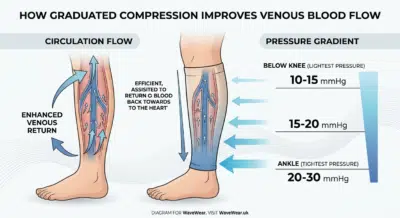
Calf compression sleeves assist this process directly. By applying pressure that is greatest at the ankle and decreasing toward the knee, they create a mechanical pressure gradient that nudges blood upward – in exactly the direction the body’s venous return system is designed to move it.
Think of squeezing toothpaste from the bottom of the tube rather than the middle. Pressure applied at the base moves fluid upward far more effectively than pressure applied uniformly or from above.
A study published in the Journal of Strength and Conditioning Research found that venous blood flow velocity increases measurably when compression of 15–20 mmHg is applied to the lower leg. This effect is most pronounced when a person is upright and active – precisely why compression works well during exercise and travel, and provides limited benefit when lying flat in bed.
Muscle Vibration Dampening
Every time your foot contacts the ground during a run, a shockwave travels upward through the lower leg. Your soft tissue – muscle, fat, and skin – vibrates in response to that repeated impact.
What repeated vibration does over time:
- Causes micro-tears in muscle fibres.
- Reduces motor unit firing efficiency.
- Accelerates fatigue accumulation over long efforts.
Research published in the Journal of Strength and Conditioning Research confirmed that lower-limb compression garments effectively reduce muscle displacement, soft tissue vibrations, and muscle activation associated with the impact forces generated during running. A separate controlled study on downhill running found that compression reduced soft tissue vibration magnitude by 15% and vibration frequency by nearly 12%.
In practical terms: your muscles do less mechanical damage-control work per stride and retain more contractile strength across a long effort. The effect is most meaningful after approximately 45–60 minutes of continuous running – in the first two miles, your legs feel fresh regardless of what you are wearing, but by mile ten or twelve, the cumulative difference starts to matter.
Metabolic Waste Clearance
During intense exercise, working muscles produce lactic acid and other metabolic byproducts faster than the bloodstream can remove them. The burning sensation that builds in the calves during a hard run or bike climb is partly this accumulation.
How compression helps:
- Accelerates blood flow velocity in the lower leg.
- Speeds clearance of lactic acid and creatine kinase from muscle tissue.
- Reduces the duration and severity of post-exercise muscle soreness.
According to the Cleveland Clinic, improved circulation from compression therapy can reduce muscle soreness and promote faster recovery – which is why compression delivers its strongest measurable benefit in the post-exercise window, when the goal shifts from performance to repair.
Proprioception: The Benefit Nobody Talks About
There is a fourth mechanism that appears in sports science research but is almost never covered in articles about calf sleeves: proprioception.
Proprioception is your body’s ability to sense the position of your limbs without visual feedback. When a compression sleeve is in contact with the calf, it increases the density of tactile feedback from that area, giving the nervous system a more precise picture of where the ankle sits in space at any moment.
Why this matters in practice:
- For trail runners on uneven ground, it reduces the risk of ankle inversion injuries (rolling the ankle).
- For hikers on rocky terrain, it sharpens foot placement on unpredictable surfaces.
- For team sport athletes changing direction under fatigue, the additional feedback reduces missteps late in matches.
- It also partially compensates for the fatigue-related decline in proprioceptive accuracy that occurs in the later stages of long efforts – helping athletes maintain safer foot placement when their legs are most tired.
7 Evidence-Backed Benefits of Calf Compression Sleeves
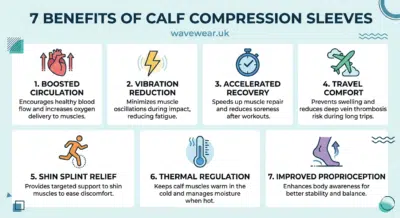
The benefits below are supported by published research. Each one is paired with the specific audience it serves most meaningfully – because the physiology matters differently depending on whether you are a runner at mile eighteen, a nurse six hours into a shift, or a traveller in seat 42B.
Benefit 1: Enhanced Blood Circulation
How it works: Graduated compression narrows the diameter of superficial veins, increasing the velocity of blood flow back toward the heart. The result is more efficient oxygen delivery to active muscles and faster removal of metabolic waste products from tissue.
Who benefits most:
| User Type | Why It Matters |
| Endurance athletes (runners, cyclists, hikers) | Sustained oxygen delivery over 60-minute-plus efforts. |
| Desk workers sitting 4+ consecutive hours | Blood pools naturally without muscular activity. |
| Long-haul travellers | DVT prevention – see Benefit 4 for the research. |
| People in standing occupations | The stationary upright position challenges venous return without walking. |
Benefit 2: Reduced Muscle Vibration and Fatigue
How it works: Compression stabilises soft tissue against the underlying muscle and bone structure, reducing the amplitude of vibrations generated by repeated impact. Fewer vibrations mean:
- Fewer micro-tears per hour of activity.
- More retained muscle strength late in a long effort.
- Less soreness in the 24–72 hours that follow.
Who benefits most:
- Road runners training at 40+ miles per week, where cumulative vibration damage builds progressively across sessions.
- Trail runners and hikers on steep or uneven downhill terrain, where eccentric loading amplifies impact forces significantly.
- Athletes in impact sports – basketball, football, and tennis players with repeated jumping, landing, and rapid direction changes.
Worth knowing: Compression sleeves deliver their biggest noticeable difference during long efforts, not short sessions. The vibration-protection benefit does not accumulate meaningfully on a twenty-minute jog. Over ninety minutes or more, it becomes significant.
Benefit 3: Faster Post-Workout Recovery and Reduced DOMS
This is the area where the evidence for calf compression sleeves is arguably strongest and most consistent.
What the research shows:
- A meta-analysis of twelve controlled studies found compression garments had a statistically significant moderate effect on reducing delayed onset muscle soreness (DOMS).
- Meaningful improvements were recorded in muscle strength and power recovery in the 24–72 hours following damaging exercise.
- A separate 2022 PMC systematic review confirmed the consistent role of compression in alleviating post-exercise fatigue symptoms and supporting muscle damage recovery.
DOMS typically peaks 24–72 hours after intense exercise. Wearing a sleeve for 2–4 hours post-workout supports:
- The clearance of inflammatory byproducts from calf tissue.
- Reduction of excess fluid accumulation in fatigued muscles.
- Circulation of repair proteins to micro-damaged fibres.
Who benefits most:
- High-frequency trainers – athletes training five or more days per week who cannot afford complete rest days.
- Race-preparation athletes – runners or cyclists in high-volume training blocks where recovery speed determines next-session quality.
- Gym athletes and CrossFit participants – anyone performing eccentric-heavy movements such as deadlifts, box jumps, and stair climbing.
The timing detail that matters: Put the sleeve on within 30 minutes of finishing exercise. During this window, blood vessels are temporarily more permeable – a state of elevated capillary permeability – allowing compression-assisted circulation to clear metabolic waste far more efficiently than it would hours later.
Benefit 4: Swelling Prevention and Fluid Management
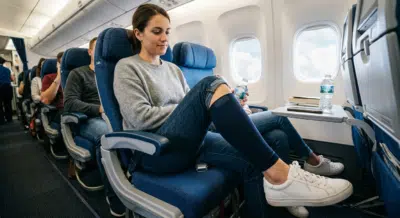
Prolonged sitting or standing without active movement allows fluid to pool in the lower legs. Most people recognise this as swollen ankles after a long flight or heavy, puffy calves after a full day on their feet. The medical term is dependent oedema – and graduated compression is one of the most effective non-pharmacological interventions for it.
What the research shows:
- A Cochrane review of 12 randomised controlled trials involving 2,918 participants found high-certainty evidence that graduated compression reduces the risk of symptomless DVT in long-haul flight passengers.
- One landmark study (The Lancet, 2001) found symptomless DVT occurred in 10% of long-haul travellers wearing no compression, compared with zero cases among those wearing graduated compression garments throughout the flight.
Who benefits most:
- Frequent flyers – particularly on routes exceeding four hours.
- Healthcare, hospitality, and retail workers – nurses, teachers, and shop floor staff standing for 8–12-hour shifts.
- Pregnant women – pregnancy substantially increases blood clot risk and lower-leg swelling, according to the CDC. Compression is a commonly recommended daily-wear tool during the second and third trimesters.
- Anyone whose ankles swell toward the end of a typical working day – a reliable indicator that daily venous return support would be genuinely beneficial.
Benefit 5: Shin Splint Symptom Management
Shin splints – medically classified as medial tibial stress syndrome – occur when the muscles, tendons, and periosteal tissue around the tibia become overloaded from repetitive mechanical stress. The pain runs along the inner edge of the shinbone and typically intensifies with continued activity.
How calf compression sleeves help – two mechanisms:
- Vibration reduction – dampens tibial vibration and muscle oscillation, decreasing the repetitive stress applied to the periosteal tissue (the thin covering layer of the bone) central to the injury mechanism.
- Improved local blood flow – enhanced circulation helps reduce localised inflammation and accelerates clearance of inflammatory byproducts from surrounding tissue.
Important caveat: Compression sleeves manage shin splint symptoms. They do not repair the underlying tissue damage. Shin splints require a genuine reduction in training load, a review of footwear and running surface, and in many cases gait assessment by a physiotherapist. Using a sleeve to push through shin splint pain without addressing its root cause reliably prolongs recovery.
Who benefits most:
- Runners with a prior history of shin splints – seeking symptom relief during activity and reduced recurrence risk.
- New runners increasing mileage too quickly – shin splints are significantly more common in the first 8–12 weeks of a new running programme.
Benefit 6: Thermal Regulation
Technical compression fabrics – typically nylon-spandex blends – create a regulated microclimate between the sleeve surface and the skin.
Season-by-season benefit:
| Condition | What the fabric does | Practical benefit |
| Cold weather | Traps a film of warm air close to the skin. | Keeps calf muscles warmer in the first 15 minutes of a cold run, reducing stiffness and injury risk. |
| Warm weather | Wicks moisture away from the skin for evaporative cooling. | Skin stays drier and cooler than with cotton or bamboo alternatives. |
Who benefits most:
- Year-round outdoor athletes – runners, cyclists, and hikers training across a full range of seasonal temperatures.
- Winter runners – who experience noticeable calf tightness in the early miles of cold-weather sessions.
- Summer athletes – needing lower-leg coverage for UV protection or terrain reasons without overheating.
Benefit 7: Proprioceptive Awareness and Ankle Stability
As covered in the biomechanics section above, the tactile feedback from a well-fitted compression sleeve improves the brain’s real-time sense of ankle and lower-leg position. This enhanced proprioception reduces the risk of inversion ankle sprains on uneven or unpredictable surfaces.
Who benefits most:
- Trail runners and hikers on rocky, rooted, or cambered terrain.
- Team sport athletes – football, basketball, and tennis players making rapid lateral direction changes under fatigue.
- Runners with a history of ankle sprains – for whom an extra layer of sensory feedback provides a meaningful safety margin.
When to Wear Calf Compression Sleeves: A Practical Timing Guide
Knowing what calf compression sleeves do is only half the picture. The other half is timing – wearing them at the right moment, for the right duration, with the right expectation for each scenario.
The direct answer at a glance:
| Goal | When to Wear | Duration |
| Athletic performance | Before exercise sessions of 45+ minutes. | Throughout the full session. |
| Post-workout recovery | Within 30 minutes of finishing exercise. | 2–4 hours post-workout. |
| Travel swelling prevention | Before sitting down at the start of the journey. | Full flight or journey duration. |
| Standing occupation support | Before starting the shift. | Full working day (remove before sleeping). |
During Exercise: Performance and Stability
For workouts under 30–40 minutes, the physiological benefits of compression are limited – venous return assistance and vibration dampening require sustained, repetitive activity to produce a meaningful cumulative effect.
For sessions lasting 45 minutes or longer – the case for wearing a sleeve is well supported.
Activities where calf compression sleeves are most effective:
- Long-distance running (road and trail).
- Cycling rides lasting 60 minutes or more.
- Extended hikes, especially on downhill terrain.
- Hyrox, CrossFit, and functional fitness sessions with repeated calf loading.
- Team sport matches with sustained high-intensity play.
Practical points for exercising with compression sleeves:
- Put the sleeves on before you begin, not partway through the session.
- Applying compression to already-swollen, fatigued muscles mid-workout is both harder and less effective.
- Ensure the sleeve sits correctly – 2–3 cm below the back of the knee – before you start moving.
The Post-Workout Recovery Window: The 2–4 Hour Rule
This is the timing that the majority of compression sleeve users get wrong – and it is arguably where the sleeves deliver their single largest measurable benefit.
In the 30–60 minutes following exercise, the body enters a state of elevated capillary permeability. During this physiological window, compression-assisted blood flow is at its most effective because it:
- Clears lactic acid and creatine kinase from muscle tissue more quickly.
- Reduces accumulation of inflammatory fluid in the calf muscles.
- Supports circulation of repair proteins to micro-damaged fibres.
The rule: Wear the sleeve for 2–4 hours post-workout. There is no significant benefit to wearing it beyond this – the peak recovery window closes, and extended passive wear without activity produces diminishing returns.
Putting the sleeve on within thirty minutes of finishing captures the most important physiological window. Showering first and applying it an hour later is better than nothing – but it is not the same.
Long-Haul Travel and Sedentary Periods
For flights over four hours, extended car journeys, or long days of seated office work, the goal shifts completely from performance to swelling prevention.
Practical guidance for travel and sedentary wear:
- Put the sleeve on before sitting down – preventing fluid pooling is considerably easier than reversing it once it has occurred.
- Stand and walk for 2–5 minutes every hour, even when wearing compression. Movement activates the calf muscle pump and amplifies the sleeve’s benefit.
- Stay well hydrated throughout travel. Dehydration increases blood viscosity and raises clotting risk independently of whether compression is worn.
- Do not rely on the sleeve alone without periodic movement. Compression augments the calf pump – it does not replace it.
Standing Occupations: The Daily Wear Case
Nurses, teachers, retail staff, hospitality professionals, and any worker spending 8–12 hours standing face a daily circulatory challenge that has nothing to do with sport. For this group, compression sleeves are a daily-wear comfort and vascular health tool, not a performance or recovery product.
Daily wear recommendation by occupation:
- Nurses and healthcare workers – 15–20 mmHg for full-shift support.
- Retail and hospitality staff – 8–15 mmHg for comfortable all-day wear.
- Office workers who stand at desk setups – 8–15 mmHg for mild fatigue prevention.
- Anyone with diagnosed venous insufficiency or varicose veins – consult a doctor before choosing a compression level.
When NOT to Wear Calf Compression Sleeves
This section is as important as all of the usage guidance above. There are specific situations where wearing a calf compression sleeve is either ineffective or directly counterproductive.
| Situation | Why to Avoid |
| During sleep | The horizontal position removes the gravitational component that makes graduated compression effective. Uniform pressure without directional benefit – and can cause overnight discomfort. |
| Peripheral artery disease (PAD) | PAD narrows the arteries supplying blood to the legs. Adding compression to already -reduced arterial inflow can restrict circulation further. Consult a doctor first. |
| Open wounds or active skin infections | Compression over broken or infected skin risks worsening the condition. Wait until the skin has fully healed. |
| Acute, unexplained calf pain | Sudden intense calf pain with warmth, redness, or new swelling can indicate deep vein thrombosis. Do not apply compression. Seek medical attention immediately. |
How to Choose the Right Compression Level: The mmHg Guide Made Simple
mmHg stands for millimetres of mercury – the same unit used to measure blood pressure. When a calf sleeve is labelled 15–20 mmHg, it means the sleeve delivers between 15 and 20 millimetres of mercury pressure at the ankle, tapering progressively toward the knee.
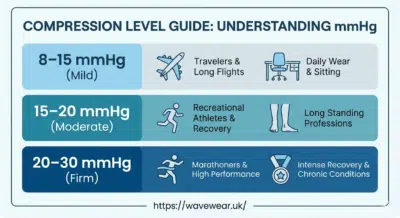
In everyday reference terms:
| mmHg Level | How It Feels | Best Starting Point For |
| 8–15 mmHg | Barely noticeable – snug but gentle. | First-time users, travel, office work. |
| 15–20 mmHg | Clearly firm and purposeful. | Most athletes, general recovery, standing work. |
| 20–30 mmHg | Strong and deliberate – noticeable all day. | High-intensity training, chronic fatigue. |
| Above 30 mmHg | Medical-grade – requires professional fitting. | Prescribed conditions only. |
8–15 mmHg – Mild Compression
Best suited for:
- Everyday leg comfort and mild end-of-day fatigue prevention.
- Long-distance travel – flights, train journeys, and extended car trips.
- Office workers who sit for the majority of the working day.
- First-time compression users starting at the gentler end of the therapeutic range.
- Light preventive use during pregnancy (always confirm with a midwife or obstetrician first).
The lightest therapeutic range. Provides genuine circulatory benefit without the firmness that some new users find unfamiliar. Well suited as an all-day everyday choice for most healthy adults.
15–20 mmHg – Moderate Compression
Best suited for:
- Recreational and club-level athletes – runners, cyclists, and hikers.
- Post-workout recovery after sessions lasting 45–90 minutes.
- Standing occupations with moderate daily leg fatigue.
- Travellers with a personal or family history of lower-leg swelling.
- Anyone returning to activity following a calf strain or shin splint episode.
This is the most commonly recommended starting point and the most versatile level in the therapeutic range. Firm enough to deliver meaningful venous return assistance and muscle stabilisation – comfortable enough to wear across a full day.
20–30 mmHg – Firm Compression
Best suited for:
- High-intensity endurance athletes – marathon runners, ultra-distance runners, and Ironman triathletes.
- People with chronic lower-leg fatigue or moderate varicose veins experiencing daily symptoms.
- Athletes in structured rehabilitation following significant calf injuries or lower-limb surgery (under physiotherapist guidance).
- Healthcare and standing workers experiencing pronounced swelling by end of shift.
At this level, the compression is noticeable from the moment the sleeve is on. It should feel firm and supportive throughout – never painful, never causing numbness or tingling. If it does, the level is too high for the current sizing.
Above 30 mmHg – Medical Grade, Prescription Only
Compression above 30 mmHg is prescribed for diagnosed venous conditions including severe varicose veins, lymphoedema, and post-surgical lower-limb swelling. It requires professional fitting. Do not self-select this level.
The Recommendation if You Are Unsure
Start at 15–20 mmHg. It is the safest all-purpose entry point for new users across every activity type and daily-use scenario.
After a few weeks of regular use:
- If compression feels insufficiently firm during training → move up to 20–30 mmHg.
- If it feels uncomfortable or restrictive during daily wear → try 8–15 mmHg instead.
How to Measure and Size Calf Compression Sleeves Correctly
A calf compression sleeve that is the wrong size does not just underperform – it can actively cause harm. Too tight and it restricts the very circulation it is designed to support. Too loose and it provides no graduated compression, slips during activity, and bunches at the ankle.
Sizing correctly takes approximately five minutes and makes a significant difference to both effectiveness and daily comfort.
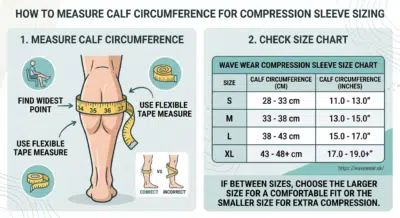
1: Measure in the Evening, Not the Morning
Your calves are at their most swollen in the evening – after hours of standing, sitting, and movement. If you measure first thing in the morning, you risk choosing a sleeve that fits comfortably at 7 a.m. but becomes tight and uncomfortable by mid-afternoon.
Evening measurement captures your natural daily fluctuation and gives you a circumference that works reliably throughout the day – not just when your legs are rested.
2: Find the Widest Point of Your Calf
Follow these steps exactly:
- Stand with your weight distributed evenly across both feet.
- Use a flexible fabric tape measure – not a rigid ruler.
- Locate the widest point of your calf, typically 8–12 cm below the back of the knee at the fullest part of the gastrocnemius muscle.
- Hold the tape snugly against the skin without pulling it tight – you want body circumference, not compressed circumference.
- Record the measurement in centimetres.
3: Measure Calf Height
Measure from the narrowest point just above your ankle bone to just below the crease at the back of your knee. Most standard adult calf sleeves are designed for calf heights between 35 and 42 cm.
The WaveWear C2 Calf Compression Sleeve is available in sizes S, M, L, and XL – covering calf circumferences from 30 cm to 48 cm. The full sizing chart is available on the product page to cross-reference your measurements before buying.
| Size | Calf Circumference | Sleeve Length |
| S | 30–36 cm | 30 cm |
| M | 37–40 cm | 30 cm |
| L | 41–44 cm | 34 cm |
| XL | 45–48 cm | 34 cm |
4: Match to the Size Chart – Go Up If In Doubt
If your measurement falls on the border between two sizes, always go up rather than down.
- A sleeve that is marginally too large will feel slightly snugger once on and warmed by body heat – that is entirely acceptable.
- A sleeve that is even slightly too small creates a genuine risk of numbness, restricted circulation, and the persistent skin impressions that indicate over-compression.
5: The Fit Check Once the Sleeve Is On
A correctly fitted calf compression sleeve must meet all four of these criteria:
- Firmness without pain – feels clearly firm from the moment it is on, but never tight enough to cause discomfort.
- One-finger clearance – you can slide one finger under the top edge without significant resistance.
- Positional stability – stays in place during walking and running without slipping toward the ankle or bunching.
- Normal sensation – no numbness, tingling, or colour change (pale or bluish skin) in the foot or lower calf.
A sleeve that feels fine at rest but becomes uncomfortable during a run is almost always a sizing problem – not a product problem.
What to Look for in Fabric and Construction
Not all calf compression sleeves are built the same way. Fabric composition and construction details determine whether a sleeve delivers accurate, consistent graduated compression across months of regular use – or whether it feels right for three weeks and then loses its shape.
Nylon-Spandex Blends: The Functional Standard
The most effective compression sleeves use a nylon-spandex blend, typically in the ratio of 70–85% nylon to 15–30% spandex (also marketed as elastane or Lycra).
What each component contributes:
| Material | Role | What happens without it |
| Nylon | Structural integrity – maintains the shape and compression geometry. | Sleeve loses its position and pressure gradient. |
| Spandex | Elastic memory – returns to original shape after every stretch. | Compression accuracy degrades progressively with washing. |
Why cotton is not suitable for compression sleeves:
- Cotton absorbs sweat and retains it within the fabric structure.
- During exercise, this produces a heavy, wet sleeve against the skin – increasing friction, chafing, and bacterial growth.
- Cotton also loses dimensional stability when wet, meaning it delivers inconsistent compression the moment you begin to perspire.
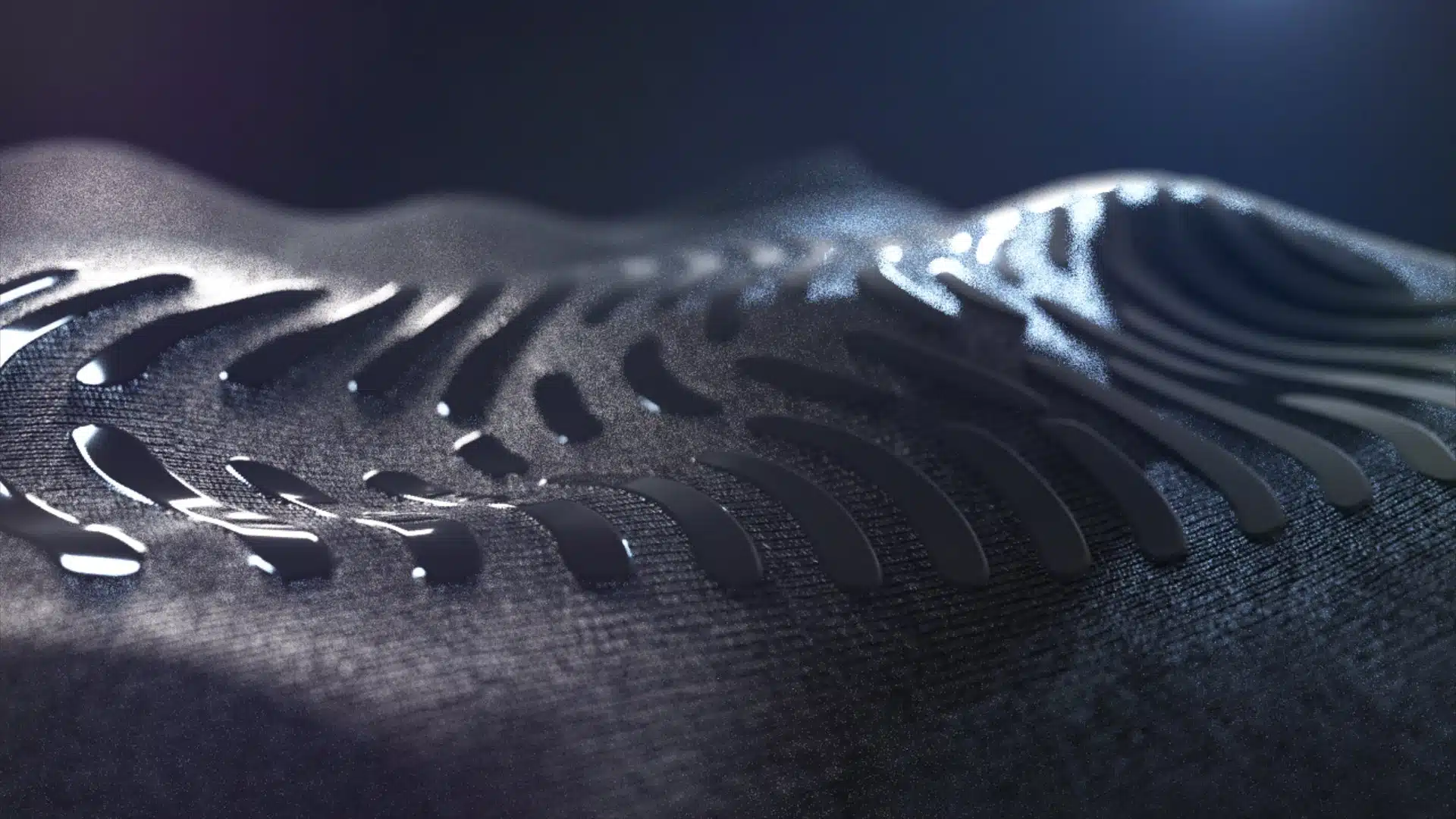
The WaveWear C2 uses a 72% nylon / 28% spandex blend with proprietary Adhesive Silicone BWAS™ technology – combining the compression benefit with a built-in kinesiology taping effect on the inner surface of the sleeve.
Moisture-Wicking vs. Moisture-Absorbing: A Critical Distinction
| Fabric type | Behaviour | Effect during exercise |
| Moisture-absorbing (cotton, bamboo) | Draws sweat into the fabric and holds it. | Heavy, wet, cold in wind, odour-prone. |
| Moisture-wicking (technical nylon, polyester) | Pulls sweat to the outer surface for evaporation. | Skin stays dry, sleeve stays light, compression maintained. |
For any compression sleeve worn during physical activity or extended daily wear, moisture-wicking technical fabrics are the correct choice without exception.
Flatlock Seams: The Construction Detail That Prevents Blisters
Standard sewn seams create a raised ridge on the inner face of the garment. On a compression sleeve worn during four hours of running, a raised inner seam crossing the calf can cause significant blistering and chafing – particularly at points of maximum leg flexion.
Flatlock seaming joins fabric panels edge to edge, producing a seam that lies entirely flat against the skin. This is a construction standard used in sports-grade compression garments and one of the most meaningful differences between athletic-grade and general-use sleeves.
Antimicrobial Treatment: Practical for Daily Wearers
For those who wear compression daily – nurses, standing workers, or athletes training twice a day – sleeves incorporating silver-ion or zinc-oxide antimicrobial treatments inhibit bacterial growth between washes and extend the period before odour becomes noticeable.
Calf Compression Sleeves vs. Compression Socks: Which Do You Actually Need?
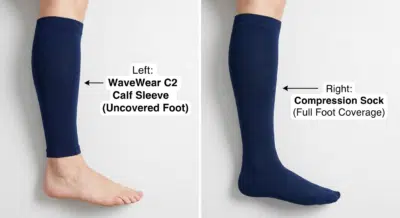
The core anatomical difference is simple: compression socks cover the foot and ankle as well as the calf. Sleeves cover only the calf and leave the foot entirely free.
Choose Calf Compression Sleeves When:
- You want to wear your own specialist socks alongside – blister-prevention socks for trail running, thin-contact cycling socks for clip-in shoes, or wool socks for cold-weather hiking.
- You are active in warm conditions and want to minimise total fabric coverage on the lower leg.
- Your recovery or support need is specifically in the calf – not the ankle or foot.
- You wear them in a professional setting and want flexibility to pair them with your preferred footwear.
- You are doing Hyrox, CrossFit, or gym-based training where boot or shoe compatibility matters.
Choose Compression Socks When:
- You need foot, arch, or ankle compression – for plantar fasciitis, diabetic foot care, post-surgical swelling, or ankle oedema.
- You prefer an all-in-one lower-leg solution and have no need to layer with other socks.
- You have ankle swelling as well as calf swelling and need graduated pressure from toes to knee.
The physiological bottom line: There is no advantage to compression socks over sleeves for pure calf recovery and venous return purposes. The compression function above the ankle is identical in both garment types. The decision comes down to what your feet and ankles specifically need.
If you need full lower-leg and knee coverage beyond the calf, the WaveWear compression leggings range – including the Men’s Knee and Calf Kinetic Tape Compression Leggings and Women’s Knee and Calf Recovery Tape Compression Leggings – extends the taping and compression benefit from the calf all the way to the thigh.
How to Put On, Wear, and Care for Your Calf Compression Sleeves
Getting the most from a compression sleeve comes down to doing a handful of small things correctly. None of them are complicated, but each one has a measurable effect on comfort and how long the sleeve continues to perform as designed.
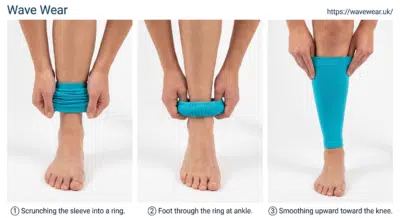
How to Put Them On Correctly
The most common mistake is rolling the sleeve up from the ankle – which creates uneven tension and causes fabric to bunch at the narrowest calf points. Here is the correct method:
- Scrunch the sleeve down into a compact ring – like scrunching a sock before stepping into it. Aim for a doughnut of fabric, not an extended tube.
- Step your foot through the ring and position the lower edge just above the ankle bone.
- Unroll and smooth upward gradually toward the knee, pulling the sleeve evenly on all sides – not tugging from one side only.
- Position the top edge 2–3 cm below the crease of the knee. Above this point restricts knee flexion; below it misaligns the compression gradient.
- Smooth the entire sleeve with your hand to eliminate any bunched areas. Bunched fabric creates localised pressure points – zones of excessive compression surrounded by areas receiving none.
Best Time to Put Them On
- For daily wear or travel: Put the sleeve on in the morning before standing up, while the legs are at their least swollen. A sleeve that goes on comfortably in the morning will stay comfortable throughout the day.
- For post-workout recovery: Put the sleeve on within thirty minutes of finishing exercise, to capture the elevated capillary permeability window.
Skin Preparation Before Wearing
Apply compression sleeves to clean, dry skin only. Avoid moisturiser, sunscreen, massage oil, or any topical product beforehand. These lubricants:
- Cause the sleeve to migrate downward during activity – producing ankle bunching rather than calf compression.
- Degrade the spandex elastic fibres over repeated applications, progressively reducing compression accuracy.
For the WaveWear C2 specifically: the inner BWAS™ Adhesive Silicone layer requires clean skin for optimal adhesion. Check that the silicone surface is free of lint or dust before each wear.
Washing and Care
Preferred method: Hand wash in cool water with a gentle detergent. Rinse thoroughly and air dry flat in the shade.
Machine washing: Cold water delicate cycle inside a mesh laundry bag. Turn the sleeve inside out so the silicone layer faces inward.
The non-negotiable rule: no heat. A single hot wash cycle or tumble dryer session can permanently reduce compression accuracy by 10–20%. The elastic fibres do not recover from heat damage.
| Do | Do Not |
| Hand wash in cool water. | Machine wash on warm or hot cycle. |
| Machine wash on cold delicate in a mesh bag. | Tumble dry at any temperature. |
| Air dry flat in the shade. | Dry in direct sunlight (UV degrades spandex). |
| Wash after every 2–3 uses. | Iron the sleeve. |
When to Replace Your Sleeves
Most compression sleeves begin to lose meaningful compression accuracy after approximately six months of regular use at 3–5 sessions per week.
The snap-back test:
- Lay the sleeve flat on a surface.
- Stretch it to approximately double its resting width.
- Release it and observe the return.
- Pass: Returns to original shape within one second – compression intact.
- Fail: Returns slowly, only partially, or remains stretched – elastic memory lost, no longer delivering accurate graduated compression.
Warning Signs: When Your Sleeve Is Not Working or Is Making Things Worse
Calf compression sleeves are safe for the vast majority of people when correctly fitted and used appropriately. The following warning signs indicate a problem that must be addressed.
Warning Sign 1: Numbness or Tingling During Wear
A pins-and-needles sensation, numbness, or tingling in the calf or foot indicates nerve compression from excessive external pressure.
Immediate action:
- Remove the sleeve at once.
- Elevate the leg and rest for ten minutes until sensation fully normalises.
- Reassess sizing before wearing the sleeve again.
Warning Sign 2: Skin Colour Changes
If the foot, toes, or lower calf turns pale, distinctly bluish, or develops unusual redness while the sleeve is on – remove it immediately. Colour changes indicate circulatory restriction. Elevate the leg and allow sensation and colour to return to normal before making any further sizing decisions.
Warning Sign 3: Deep Skin Impressions After Removal
| What you see | What it means | What to do |
| Light temporary ring fading within 5–10 minutes. | Normal – no action required. | Continue wearing as normal. |
| Deep indentations visible 20+ minutes after removal. | Sleeve is too tight – tissue was displaced. | Correct sizing or compression level before wearing again. |
Warning Sign 4: Worsening or New Pain During Wear
Increasing lower-leg pain – particularly with localised warmth, visible redness, or new swelling – is a reason to remove the sleeve and seek medical advice without delay. These symptoms can indicate a deep vein thrombosis (DVT) or compartment syndrome. Both require medical evaluation.
Who Should Consult a Doctor Before Use
The following individuals should speak with a healthcare professional before beginning compression sleeve use:
- People with a confirmed diagnosis of peripheral artery disease or arterial insufficiency.
- Individuals with diabetes who have any loss of sensation in the feet or lower legs (peripheral neuropathy).
- Anyone with active skin infections, open wounds, ulcers, or active dermatitis on the lower leg.
- People with a personal history of blood clots or inherited clotting disorders.
- Anyone who has undergone lower-limb surgery within the preceding three months.
5 Common Myths About Calf Compression Sleeves – Debunked
A significant amount of misinformation about calf compression sleeves circulates online and in athletic communities. Some is harmless. Some leads people to misuse a genuinely useful tool – or dismiss it entirely.
Myth 1: “They Are Only for Serious Athletes”
The myth: Compression sleeves are specialist gear for elite runners and cyclists.
The reality: The challenge that calf compression sleeves address – venous return and blood pooling – is not an athletic problem. It is a gravitational one.
Gravity applies equal downward force on every human circulatory system, regardless of fitness level. Consider who actually benefits most:
- A nurse standing for ten consecutive hours.
- A teacher on their feet all day.
- A pregnant woman in her third trimester.
- A 65-year-old on a transatlantic flight.
Each of these people has as great or greater need for lower-leg circulatory support as any recreational runner. The compression sleeve market is now shaped predominantly by non-athletes – healthcare professionals, office workers, travellers, and pregnant women represent the fastest-growing user groups.
Myth 2: “Tighter Compression Is Always Better”
The myth: More pressure = more benefit.
The reality: This is the most physically dangerous misconception about compression wear. Compression that is too tight does not deliver more benefit – it restricts the circulation it is designed to improve.
Signs that your compression level is too high:
- Discomfort within the first ten minutes of wear.
- Requiring deliberate breathing to tolerate the sensation of putting the sleeve on.
- Any numbness, tingling, or skin colour change during wear.
The correct compression level feels firm and purposeful – never painful, never requiring conscious adjustment to tolerate.
Myth 3: “Compression Sleeves Cure Shin Splints and Calf Injuries”
The myth: Wearing a sleeve will fix the injury.
The reality: Compression sleeves reduce the symptoms of shin splints – the pain, inflammation, and discomfort that make activity difficult. They do not repair the underlying tissue damage.
The underlying problem – overloaded periosteal tissue driven by excessive training load, biomechanical inefficiency, or inadequate footwear – requires rest and professional assessment to resolve properly. Using a sleeve to suppress pain without addressing its source is a reliable path from a short-term problem to a chronic one.
Myth 4: “You Can Wear Them Overnight for Extra Recovery”
The myth: Sleeping in compression sleeves accelerates recovery.
The reality: Graduated compression is designed for an upright posture. It works by creating a pressure gradient that assists venous blood flow against gravity. When lying flat:
- Gravity is no longer a challenge for venous return.
- Pressure becomes uniform across the calf – not graduated.
- Uniform pressure without directional component provides no meaningful circulatory assist.
Research consistently fails to identify meaningful recovery advantages from overnight wear compared with 2–4 hours post-exercise in an upright position.
Myth 5: “All Compression Sleeves Are Essentially the Same”
The myth: A £7 pair does the same job as a £35 pair.
The reality: They do not – and the difference matters significantly over time.
What separates quality from budget compression sleeves:
| Feature | Quality sleeve | Budget sleeve |
| Compression type | True graduated – tightest at ankle, tapering toward knee. | Often uniform pressure – no gradient. |
| Fabric durability | Maintains compression accuracy for 6+ months. | Loses shape within weeks of regular washing. |
| Seam construction | Flatlock seams – lie flat against skin. | Raised seams – cause blistering during sustained activity. |
| Certified mmHg | Independently tested and verified. | Often unlabelled or unverified. |
When evaluating any compression sleeve, ask whether the compression gradient is independently tested and certified, and what the verified mmHg range at the ankle actually measures.

Frequently Asked Questions
Are calf compression sleeves good for shin splints?
Yes – they help manage shin splint symptoms by reducing tibial vibration and improving local blood flow to reduce inflammation. They do not treat the root cause. Rest, load management, and physiotherapy are still required for full recovery.
Do calf compression sleeves actually work?
Yes, when sized correctly and worn at the right time. Published research supports their effectiveness for improving venous circulation, reducing muscle vibration during running, speeding recovery from DOMS, and preventing travel-related leg swelling. A poorly fitted sleeve at the wrong compression level will not deliver these outcomes.
How long should you wear a calf compression sleeve?
- During exercise: Throughout the full session.
- Post-workout recovery: 2–4 hours after finishing, applied within thirty minutes of stopping.
- Travel or standing work: Throughout the full journey or shift.
- During sleep: Not recommended – see the timing guide above.
Can I wear calf compression sleeves all day?
Yes, for most people, in the 8–20 mmHg range. Remove them before sleeping – horizontal positioning removes the gradient that makes graduated compression effective. Remove immediately if you experience numbness, tingling, or colour changes.
What is the difference between calf compression sleeves and compression socks?
Sleeves cover only the calf, leaving the foot free. Socks cover the full lower leg including the ankle and foot. Choose sleeves for calf-specific support with footwear flexibility. Choose socks when foot, arch, or ankle compression is also required.
Are calf compression sleeves good for runners?
Yes. For runners specifically, the primary benefits are:
- Reduced muscle vibration during long efforts – reducing fatigue accumulation and DOMS.
- Improved oxygen delivery to working calf muscles.
- Faster post-run recovery when worn in the 2–4 hours following a run.
Can you wear calf compression sleeves on a plane?
Yes – and it is advisable for flights over four hours. A Cochrane review of 2,918 participants found high-certainty evidence that graduated compression significantly reduces symptomless DVT risk in long-haul passengers. Put the sleeve on before boarding and keep it on for the full flight duration.
What mmHg compression sleeve do I need?
- 8–15 mmHg – light travel, everyday comfort, first-time users.
- 15–20 mmHg – most athletic use, general recovery, standing work.
- 20–30 mmHg – high-intensity training, chronic lower-leg fatigue.
- Above 30 mmHg – medical-grade, requires professional guidance only.
Conclusion: The Straightforward Path to Finding What Works for You
Calf compression sleeves work – when they fit correctly, when the compression level matches the purpose, and when they are worn at the right time for the right duration.
The decision framework in brief:
- Identify your primary use case – athletic recovery, daily comfort, travel, standing work, or managing a specific condition such as shin splints or varicose veins.
- Match the compression level to that purpose using the mmHg guide above.
- Measure correctly in the evening, and size up rather than down at the border.
- Apply at the right time – before activity begins, or within thirty minutes post-exercise for recovery.
- Choose quality construction – certified graduated compression, moisture-wicking technical fabric, and flatlock seaming.
The gap between compression sleeves that feel like a passing gimmick and those that become a permanent part of your kit comes down to one variable: fit. A well-fitted, correctly chosen sleeve does exactly what the published research says it should. A poorly fitted or wrongly selected one does not.
Ready to find the right fit?
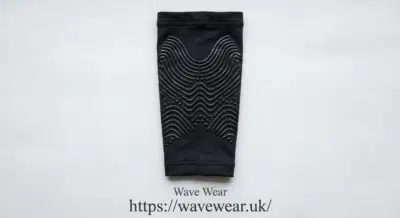
For runners, cyclists, Hyrox athletes, and anyone in high-impact functional fitness, the WaveWear C2 Calf Compression Sleeve combines certified graduated compression with built-in kinesiology taping technology (BWAS™) – delivering both the circulatory and muscle-stabilisation benefits covered throughout this guide in a single lightweight sleeve.
If you need full lower-leg and knee support for longer efforts, the Men’s Knee and Calf Kinetic Tape Compression Leggings and Women’s Knee and Calf Recovery Tape Compression Leggings extend that support from the calf to the thigh with the same taping-compression dual action.
For women combining calf support with broader athletic training, the WaveWear Women’s range covers compression options from sports bras and shorts to full leggings – all built around the same core technology.
Browse the full compression sleeve range and use the sizing chart on each product page to match your measurements before buying. Getting the size right the first time is the single most important step toward getting the results described in this guide.