FREE SHIPPING ON ORDERS OVER £70


What to Wear for Hyrox: The Ultimate UK Compression Guide 2026

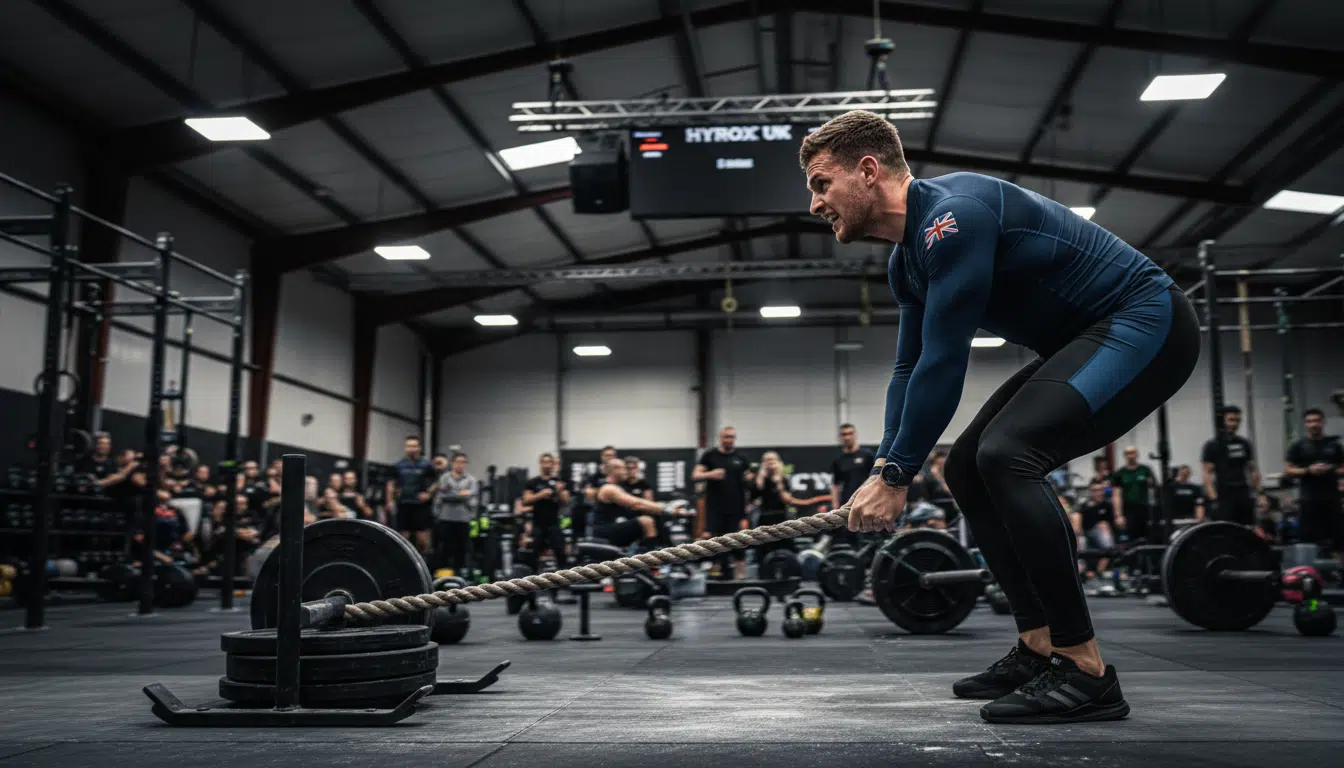
Knowing what to wear for Hyrox is not a minor detail. It is one of the few race-day decisions entirely within your control – and getting it wrong quietly costs you time, comfort, and confidence from kilometre one onwards.
What to Wear for Hyrox in the UK
For Hyrox 2026, wear graduated compression shorts or leggings, a moisture-wicking compression top with flatlock seams, and a hybrid trainer with strong multi-surface grip. Add wrist sweatbands, mid-length compression socks, and optional gloves for the sled pull and farmers carry. Never wear cotton. Test everything in training before race day.
| Body Area | What to Wear | Why It Matters |
| Upper body | Compression top, flatlock seams, 4-way stretch | SkiErg range of motion, zero shoulder friction |
| Lower body | Mid-thigh compression shorts or full-length leggings | Sandbag lunge muscle support, full burpee freedom |
| Feet | Hybrid trainer, 35–40mm stack, multi-surface grip | Sled carpet traction and 8km of cushioned running |
| Hands | Fingerless gloves (optional) | Sled pull and farmers carry grip protection |
| Wrists | Sweatband | Manages sweat during rowing, wall balls, and SkiErg |
| Post-race | Dry compression base layer plus warm outer layer | Continued venous return support, protection from cold UK venue exits |
Why Your Hyrox Kit Matters More Than You Think

Picture yourself six kilometres in. You have been through four stations already. The sled pull is next. Your hands are soaked. Sweat is blurring your vision. And your shorts have rolled down twice during the sandbag lunges – costing you seconds every time you stop to fix them.
This is not a hypothetical. It happens to athletes who treat kit as a last-minute decision.
Here is why Hyrox is different from every other race format:
- It combines 8km of running with 8 functional fitness stations – completed back to back, indoors, against a clock.
- Your kit must perform in two completely different physiological states – sustained aerobic running output AND explosive anaerobic station effort.
- Kit failures compound over 60–90 minutes – a small friction point at Station 2 becomes a raw wound by Station 7.
- No other race format creates these simultaneous demands on clothing – yet most guides still say “just wear something moisture-wicking.”
This guide has been written specifically for UK Hyrox athletes racing the 2026 season – covering Manchester, London, and Birmingham – with honest, experience-backed advice on what works, and what quietly destroys race day comfort.
Why Hyrox Demands Different Kit Than Any Other Race
Most endurance events have one physiological demand:
- Marathon running needs lightweight, breathable kit for sustained aerobic output.
- CrossFit needs flexible, durable gear for explosive gym movements.
- Hyrox needs both – alternated, eight times over, for up to 90 minutes.
The Hyrox Race Format: Why Kit Choice Is Harder Than It Looks
The race structure is simple but the clothing demands are not:
- Run 1km at race pace.
- Complete one functional fitness station.
- Run 1km again.
- Complete the next station.
- Repeat for eight full rounds without stopping.
Your body switches constantly between cardiovascular running output and anaerobic strength effort. Most clothing is engineered for one end of that spectrum. The failures that come from wearing the wrong kit are not dramatic – they are cumulative. A waistband that rolls at Station 2 becomes an active distraction by Station 6. A seam that rubs lightly on kilometre one is a friction wound by kilometre seven.
What to Wear for Each Hyrox Station: A Full Breakdown
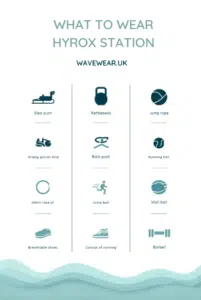
Understanding what each station specifically asks of your clothing helps you make sharper buying decisions – and stops you wearing something that looks right but fails where it counts.
- SkiErg – Both arms drive down in a wide sweeping arc, repeatedly. Raised shoulder seams create friction over hundreds of repetitions. A tight collar restricts breathing overhead. You need full, unobstructed shoulder and upper-arm freedom.
- Sled Push – Wide, low squat stance with full hip drive forward. Shorts and leggings must allow a deep, uninhibited squat position. Any waistband roll across this station distance is painful and costly.
- Sled Pull – Grip fatigue builds fast on the rope handle, especially after earlier stations. Your forearms need freedom of movement. Your palms need protection – either natural training calluses or gloves.
- Burpee Broad Jump – Full body extension from floor through to standing jump. This movement immediately exposes tight waistbands, leggings that bunch at the knee, and any top that rides up. Four-way stretch fabric is non-negotiable here.
- Rowing – Seated, forward drive with explosive hip hinge. Your lower back and torso must flex freely. Anything that pulls tight across the mid-back seam will be noticed by Station 5 and actively painful by Station 7.
- Farmers Carry – Bilateral loaded walk. Less about shoulder freedom, more about forearm circulation. Over-compressing the forearms accelerates grip fatigue going into the next running kilometre.
- Sandbag Lunges – Loaded alternating lunges across the full station distance. This is where compression leggings earn their place most clearly. Quad and hip flexor support during repeated loaded lunges is the most consistently reported benefit of lower body compression in Hyrox.
- Wall Balls – Full squat depth plus overhead throw to target. You need complete squat freedom in the lower body and unrestricted overhead reach in the upper body. Any compression top that tightens across the chest when arms go overhead costs you efficiency across the full station.
Why UK Venues Add a Variable Most Guides Ignore
- Hyrox Manchester – January race. The coldest UK Hyrox event of the season.
- Hyrox London – March and December events at Olympia and ExCeL. Venues heat up significantly mid-race.
- Hyrox Birmingham NEC – October race. Shoulder season temperature, harder flooring in transition zones.
These three venues are three meaningfully different thermal environments. Your layering strategy, sock choice, and warm-up kit should reflect exactly where you are racing – and this guide covers each one specifically.
The Science of Compression for Hyrox UK Athletes
Before investing in compression activewear for Hyrox, it is worth understanding what peer-reviewed evidence actually says – not just what marketing copy claims.
Graduated Compression vs. Uniform Compression: What Is the Difference?
Two types of compression exist and they are not the same thing:
| Type | How It Works | Who Uses It |
| Graduated compression | Applies greatest pressure at ankle or wrist, progressively reducing further up the limb | Medical-grade and high-performance sports compression |
| Uniform compression | Applies equal pressure throughout, regardless of position | Most fashion-label “compression” products |
High-performance sports compression always uses the graduated model because it works with the body’s circulatory system rather than simply squeezing the limb uniformly. In a Hyrox context, three specific mechanisms make this distinction race-relevant.
Muscle Oscillation Reduction
- Every footfall during your 8km of Hyrox running sends a shockwave through your soft tissue.
- This vibration – called muscle oscillation – is associated with micro-trauma, cumulative fatigue, and slower recovery between running segments.
- Research published in the British Journal of Sports Medicine confirms that compression garments reduce muscle oscillations during dynamic activities, and that reducing oscillation is thought to reduce muscle fatigue and tissue damage.
- In a race with eight separate running kilometres, that compounding fatigue reduction matters far more than it would in a single continuous event.
Proprioceptive Feedback
- Proprioception is your body’s awareness of its own position in space – essential for controlled movement during loaded exercises like sandbag lunges and farmers carries.
- Research indicates that compression garments may improve joint position awareness through external pressure acting on sensory receptors within the skin.
- This is why athletes consistently describe compression as feeling more connected to their movements under load – particularly relevant in the later, fatigue-heavy stations when technique is hardest to maintain.
Venous Return Support
- Research published in the Journal of Science in Medicine and Sport, using Doppler ultrasound on elite athletes, found that sports compression tights and socks increased lower-limb venous blood flow and muscle oxygenation.
- During semi-static efforts like the farmers carry, this improved circulation helps clear metabolic byproducts from working muscles – so your legs carry less accumulated fatigue into the next running kilometre.
- One study found that wearing compression socks during high-intensity running had a measurable positive effect on subsequent running performance – directly relevant in Hyrox, where you always run immediately after a station.
Learn how Wavewear’s compression technology works →
What Compression Cannot Do: The Honest Picture
| What Compression Can Help With | What Compression Cannot Do |
| Reduce muscle oscillation during running | Compensate for under-training or poor race nutrition |
| Support venous return during loaded carries | Meaningfully alter heart rate or blood pressure |
| Improve proprioception at station movements | Replace smart pacing strategy |
| Reduce perceived muscle soreness post-race | Work correctly if the garment restricts breathing at race pace |
A 2022 meta-analysis in Sports Medicine across 19 randomised controlled trials concluded that compression garments are likely to improve muscle oscillatory properties and increase arterial blood flow – but are unlikely to meaningfully alter tissue metabolism, blood pressure, heart rate, or cardiorespiratory function. The benefits are real and race-relevant. They are not miraculous.
Fashion Compression vs. Functional Compression: Why This Matters for UK Athletes
A significant portion of the UK activewear market sells garments that look like performance compression – at performance prices – without the technical construction to justify either claim.
| Feature | Fashion Compression | Functional Compression |
| Pressure profile | Uniform throughout | Graduated from extremity upward |
| Seam construction | Standard overlocked seams | Flatlock seams lying flush with skin |
| Stretch direction | One or two-way | Four-way (vertical and horizontal) |
| Elastane quality | Low-denier, degrades quickly | High-denier technical yarn |
| Wash durability | Loses compression within 20–30 washes | Maintains graduated profile through sustained use |
| Best for | Aesthetic or low-intensity activity | Sport-specific performance and recovery |
The Wavewear range uses Bio Waved Adhesive Silicone (BWAS™) technology – a construction that delivers smart compression that actively increases support when joints are under load, rather than applying the same pressure at rest and at full effort. Clinical testing showed 35% less lactic acid accumulation and 3x more pressure when bending the knee compared to standard compression. This is why it performs differently during the dynamic station movements that define Hyrox. See the full technology breakdown →
What to Wear for Hyrox: Head-to-Toe Kit Breakdown
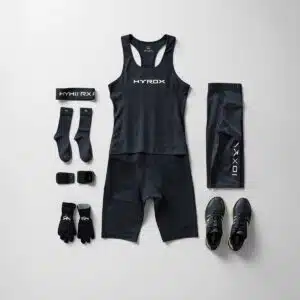
What to Wear on Your Upper Body for Hyrox
The short answer: Wear a compression top with flatlock seams, four-way stretch fabric, and a close fit that does not restrict shoulder rotation during the SkiErg.
The most critical feature on any Hyrox compression top is seam construction. Flatlock seams lie completely flat against the skin – no raised ridge. Standard overlocked seams sit up slightly. Across hundreds of SkiErg repetitions and rowing strokes, that small ridge will rub. By Station 4 it is uncomfortable. By Station 7 it is genuinely painful – and the damage is done before you notice it.
What to Look for in a Hyrox Compression Top
- Flatlock seam construction throughout – check both shoulder caps, along the underarm, and the collar line specifically.
- Four-way stretch fabric – must stretch vertically and horizontally without resistance. Test by reaching fully overhead and into a deep forward fold before purchasing.
- Technical moisture-wicking blend – polyester-elastane or nylon-elastane only. Any cotton in the blend is immediately unsuitable.
- Minimal or no collar – high collars trap heat and restrict overhead movements at the SkiErg and wall ball stations.
- Close fit without restricted breathing – stays in place through a full burpee but does not limit chest expansion at race pace.
What to Avoid
- Raised seams across the chest or either shoulder cap.
- Baggy or loose-fit tees that trap heat and flap during station transitions.
- Anything with a hood or drawstring that can snag during movements.
The Men’s Back & Shoulder Ultra Compression Top T20 features flatlock seam construction across both shoulder caps – the exact friction zone created by the SkiErg stroke pattern. The four-way stretch nylon-elastane blend delivers full overhead extension without resistance, and the moisture-wicking face fabric handles sustained sweating across the full race duration. View men’s compression tops →
UK cold weather note: For January Manchester or early March London events, a lightweight compression base layer worn under a breathable technical tee keeps you warm during warm-up without overheating once your core temperature rises mid-race. It should be thin enough that you would be comfortable wearing it alone.
What to Wear on Your Lower Body: Compression Shorts vs. Leggings for Hyrox
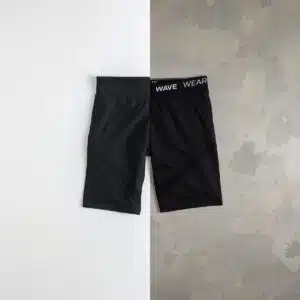
The short answer: Compression shorts suit warmer venues and give maximum freedom for Burpee Broad Jumps. Full-length compression leggings offer more muscle support for Sandbag Lunges and suit colder UK venues.
This is a genuine, situational decision. Here is the complete framework:
Choose Compression Shorts If:
- You are racing at London Olympia in March or a warm late-season event.
- Burpee Broad Jump freedom is your main concern.
- You run warm and full-length leggings feel suffocating after 3km.
- Sandbag lunges are not your primary time loss station.
Choose Compression Leggings If:
- You are racing at Manchester Central in January or Birmingham NEC in October.
- Sandbag lunges and heavy carries are your highest fatigue points.
- You have a history of calf cramping during sustained running efforts.
- You prefer the additional coverage and warmth for personal comfort.
The Hyrox Sweet Spot – Mid-Thigh Length
Many experienced UK Hyrox athletes settle on a mid-thigh or three-quarter compression length as the practical middle ground:
- Covers the quadriceps fully for lunge support.
- Does not restrict knee flexion during burpees.
- Does not generate the excess heat of full-length leggings over 8km.
- Provides more stability than short-length options for the sandbag station specifically.
The Waistband Roll Problem: How to Test Before Race Day
The biggest practical issue with lower body compression in Hyrox is waistband roll – caused by aggressive hip flexion during Burpee Broad Jumps. Test this specifically before committing:
- Put on your intended race kit.
- Perform 20 consecutive burpees at pace.
- Check the waistband position before and after.
- If it shifted even once, the garment is unsuitable for Hyrox.
The Knee & Calf Recovery Tape Compression Leggings Y20 (women) and Men’s Knee & Calf Kinetic Tape Compression Legging L20 feature double-knee taping construction – providing specific support at the knee joint during loaded lunges, the station where knee strain accumulates fastest. For athletes choosing shorts, the Active Split Shorts are built for full hip mobility across explosive functional movements and rated 5/5 by verified UK athletes.
Browse all women’s compression → | Browse all men’s compression →
What Women Should Wear for Hyrox: Sports Bra Guide
The short answer: Wear a high-impact encapsulation sports bra. The 8km of running alone demands individual-cup support – not simply a compression-band style garment.
Research consistently shows that inadequate breast support increases perceived exertion, disrupts running gait, and contributes to pain during sustained high-intensity activity. This is not a kit detail to compromise on.
What to Look for in a Hyrox Sports Bra
- Encapsulation construction – individual cups that support each side separately, not a single compression band.
- Moisture-wicking lining – prevents sweat absorption and uncomfortable added weight mid-race.
- Wide underband – distributes load evenly and reduces the chance of riding up during Burpee Broad Jumps.
- Wide-set or racerback straps – reduces the friction contact area across the upper back.
- Adjustable straps – essential for dialling in the correct fit that stays put through 8km of mixed movement.
Chafing Warning for Women
The bra strap line across the upper back is the most reliable friction point for women in Hyrox. It is caused by repeated shoulder flexion during the SkiErg, rowing, and wall ball stations.
Prevention steps:
- Apply body glide along the full strap path on both sides the evening before race day.
- Reapply on race morning before putting on the bra.
- Keep a small amount in your bag drop bag for a pre-race top-up.
What Shoes to Wear for Hyrox UK 2026
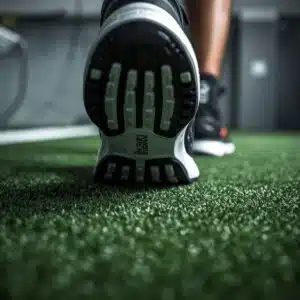
The short answer: Choose a hybrid trainer with full rubber outsole coverage, a 35–40mm stack height, a flexible forefoot, and a solid heel counter. You do not need Hyrox-specific shoes – but grip on synthetic turf sled stations is non-negotiable.
The shoe challenge in Hyrox is real and well-documented. The race demands two biomechanically opposite things from one pair of shoes simultaneously:
- For running intervals – cushioning, energy return, and lightweight responsiveness across 8km.
- For station work – traction, lateral stability, and a planted base for loaded movements on sled carpet.
Pure marathon racing shoes fail on station movements. Pure CrossFit trainers (Metcons, Nanos) are miserable over 8km of running. The right Hyrox shoe lives precisely between those two categories.
The Five Things That Actually Matter in a Hyrox Shoe
- Full rubber outsole coverage – not rubber pods with gaps of exposed foam. Exposed midsole foam on sled carpet provides almost no grip and a single slip costs 10–15 seconds.
- 35–40mm stack height – enough cushioning for 8km of impact, grounded enough for loaded station work.
- Flexible forefoot – test this in the shop by bending the front third of the shoe. If it barely bends, it will resist burpees and lunges.
- Solid heel counter – if the shoe does not hold your heel firmly during the sled push, your foot shifts inside the upper. Test for this in training specifically.
- Weight under 270g – every gram compounds across eight running intervals over 60–90 minutes.
Hybrid Trainer Benchmarks for Hyrox 2026
- Best all-rounder: PUMA Velocity Nitro 4 – most widely cited reliable choice; handles both running and stations without a major trade-off in either direction.
- Best for first-time athletes: ASICS Noosa Tri 16 – accessible price point, reliable grip, triathlete construction designed for exactly this kind of hybrid demand.
- Best for competitive athletes: PUMA Deviate Nitro Elite – more aggressive running performance; worth it only if your running splits are already doing real work for your final time.
What Hyrox Socks to Wear
A mid-length compression sock serves two practical purposes during Hyrox:
- Provides mild ankle support across all eight running kilometres.
- Creates a protective barrier between foot and sock during station movements, reducing friction hotspots under sustained load.
The 4 Pack Athletic Compression Socks cover both race day and training in one purchase – with graduated compression construction that continues to support venous return across the full race duration. For targeted ankle joint support during the sled push and loaded carry stations, the Ankle Taping Strap provides focused stability without restricting the dorsiflexion you need across the running segments. Rated 4.92/5 by verified UK athletes.
What to avoid for Hyrox socks:
- Ankle-length socks that leave the lower calf exposed during station movements.
- Excessively thick socks that alter the fit of your shoe.
- Cotton-blend socks that hold moisture against the skin.
Hyrox Accessories: The Overlooked Details That Decide Comfort
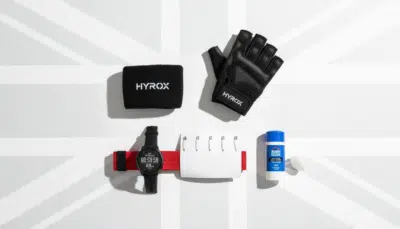
The short answer: The essential Hyrox accessories are a wrist sweatband, a GPS watch, and a race belt. Gloves are optional but recommended for athletes with lower natural grip strength.
Wrist Sweatbands
- Every station involving a handle – rowing, SkiErg, wall ball, and sled rope – generates wrist sweat that runs directly toward the hands.
- Once palms are wet, grip strength drops measurably.
- A sweatband that absorbs moisture before it reaches your hands is functional equipment, not a fashion choice.
- Wristbands are the single most underestimated piece of kit in Hyrox among first-time athletes.
Gloves for the Sled Pull and Farmers Carry
Wear gloves if:
- You experience palm soreness or skin tearing during rope pulls in training.
- Your grip gives out before the station does in training sessions.
- You have smooth palms without training calluses built up through grip-heavy work.
Skip gloves if:
- You have strong, well-callused hands from consistent grip training.
- You find gloves create extra bulk or tactile issues once your hands are warm and swollen mid-race.
Testing rule: Test any gloves during a full grip-specific training session – not just a warm-up. Hands swell under sustained exercise and gloves that fit perfectly at rest can feel restrictive mid-race.
GPS Watch – The Pacing Advantage
Using a GPS watch for pacing in Hyrox is not just about tracking your finish time. The strategic insight that experienced UK Hyrox athletes consistently report is this:
- Even pacing across all eight running intervals is one of the most controllable performance variables in the race.
- Athletes who run kilometres one to three too fast consistently deteriorate through the later intervals as accumulated station fatigue compounds on running economy.
- A watch lets you hold target pace even when your legs suggest otherwise.
- Set a per-kilometre target pace before the race and stick to it – do not run by feel when fatigue is highest.
Race Belt and Bib Holder
| Method | Effect on Compression Fabric | Recommended? |
| Safety pins | Permanently damages elastane weave; holes expand over time | Never |
| Race belt clip system | Zero kit damage; takes 30 seconds to set up | Always |
Note on Jewellery
- Rings – create painful friction during the farmers carry and SkiErg stroke.
- Necklaces – end up in your mouth during burpees. Remove all jewellery before race day without exception.
What to Wear for Hyrox at Each UK Venue in 2026

Every Hyrox race follows the same worldwide course structure. But the physical environment of each UK venue creates genuinely different clothing demands – and your kit should reflect exactly where you are racing.
London Olympia – March Events Including the EMEA Championship
London Olympia is a Victorian-era exhibition hall. It is atmospheric and impressive on race day, but it builds significant ambient heat once thousands of athletes are inside. The temperature gap between early morning and afternoon waves is noticeable and consistent.
Kit Checklist for London Olympia:
- Single compression layer only – no additional base layer underneath.
- Breathability is the priority – choose kit with mesh panel ventilation if available.
- Resist over-layering during the cool morning warm-up – core temperature rises sharply within the first two kilometres.
- Pack a warm layer specifically for post-race – exiting Olympia into West London in March in sweat-damp kit is cold within minutes.
- Compression shorts are generally the better lower-body choice for this venue’s warmth.
Manchester Central Convention Complex – January Race
Manchester in January is the coldest UK Hyrox race of the season. Arriving, queuing at registration, and warming up in race compression alone before your wave is a reliable way to lower your core temperature before the start gun. Cold muscles are stiffer muscles and produce a harder first kilometre.
Kit Checklist for Manchester:
- Lightweight compression base layer under your top – adds warmth during warm-up without overheating you mid-race.
- Compression leggings over shorts – warmth during warm-up, quad support during sandbag lunges, calf compression across all running intervals.
- Dedicated warm post-race layer in bag drop – a zip-through fleece or insulated jacket specifically for the venue exit.
- Throwaway warm-up layer for early morning wave athletes – removed and left at bag drop immediately before the start.
- Mid-length compression socks with slightly more cushion than you would wear at warmer venues.
Birmingham NEC – October Race
October at the NEC is the shoulder season – mild enough that thermal layers are unnecessary, but cool enough that shorts and a lightweight tee is comfortable throughout the race.
Kit Checklist for Birmingham NEC:
- Single compression layer – top and either shorts or leggings work well for October temperature.
- Mid-length compression sock with cushion – the NEC has harder flooring in transition zones; cushioning matters more here.
- Midsole cushioning in your shoe – for the same reason as the sock recommendation above.
- Warm post-race layer in bag drop – October evenings in Birmingham cool quickly once you leave the hall.
- Compression leggings or shorts both work at this venue – choose based on your training performance priorities.
Travelling to Your UK Hyrox Venue: What to Wear in Transit
Follow these principles regardless of which venue you are racing at:
- Travel to the venue in your warm-up or recovery layer – not your race kit.
- Warm up in that layer and change into race kit at least 20 minutes before your wave.
- This keeps your compression fresh and at full structural performance from the start gun.
- Pack a complete change of dry clothing for post-race – including fresh socks. Wet socks at a cold venue exit are miserable and the discomfort starts earlier than expected.
7 Hyrox Kit Mistakes That Cost UK Athletes Time and Comfort
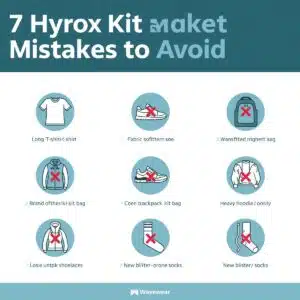
Kit mistakes rarely announce themselves dramatically. They accumulate quietly – a small discomfort here, a few seconds there – until you finish and realise every single one was preventable.
Wearing Brand-New Kit on Race Day
- New compression takes 3–5 training wears to fully conform to your body’s specific range of motion.
- Fresh from the packaging, the elastane has not yet adapted to your movement patterns.
- The waistband sits differently. Borderline seams are far more likely to cause friction before the fabric softens.
- This is one of the most consistently cited causes of avoidable chafing among Hyrox athletes at every level.
What to do instead: Wear your race kit through at least two full training sessions that replicate race-intensity effort before the event.
Choosing Aesthetics Over Function
- A compression top with a thick inner neck seam that photographs well will rub your collarbone raw by Station 3.
- Leggings without a gusset panel will restrict burpee depth regardless of how good the colourway looks.
- The UK compression market contains a significant volume of garments that look like performance wear without the technical construction to justify the name.
Before buying, test these four movements while wearing the garment:
- Full bilateral overhead extension – tests shoulder and chest restriction.
- Deep squat to maximum depth – tests hip crease and quad restriction.
- Full forward fold with hands past the knees – tests posterior chain restriction.
- A complete burpee from floor to standing jump – tests the full kit system simultaneously.
If anything resists or pulls at any point during these four tests, the garment is wrong for Hyrox.
Cotton Anything
- Cotton absorbs sweat and holds it directly against the skin – creating the wet, friction-heavy surface that causes long-distance chafing.
- The problem is not cotton while dry. It is that cotton becomes progressively worse as it absorbs more moisture – and during Hyrox you will be significantly wet from kilometre one.
Cotton also hides in unexpected places:
- Cotton underwear worn beneath compression shorts – use a built-in liner or technical boxers instead.
- Cotton-blend socks beneath compression socks – technical running socks only.
- Any base or mid-layer with even 10% cotton in the blend – at race-volume sweating, 10% is enough to cause friction.
Skipping Gloves for the Sled Pull
- The sled pull is a rope handle movement performed under accumulated fatigue, with increasingly wet hands, while your aerobic system is near its ceiling.
- For athletes without significant grip calluses, the sled pull without gloves causes palm irritation significant enough to affect farmers carry performance immediately afterward.
- Reps 5–8 on the rope are where athletes who skipped gloves most often regret the decision.
What to do instead: Test grip endurance during training sessions involving rope pulls with wet hands. If your grip gives out before the station does, gloves will earn their place on race day.
Mistake 5: Under-Layering for Winter UK Venues
- Arriving at Manchester Central in January in nothing but race compression means your core temperature drops during registration and warm-up.
- Cold muscles are measurably stiffer and less responsive at race start.
- The first running kilometre feels genuinely harder than it should when your body is still thermoregulating upward.
What to do instead:
- Bring a thin thermal or fleece layer for warm-up that can be removed and left at bag drop.
- For early morning waves, add a second throwaway warm-up layer over the top of everything.
- Never sacrifice a thorough warm-up to preserve the condition of your race kit.
Washing Compression With Fabric Softener
- Fabric softener coats elastane fibres with a conditioning agent that permanently reduces their elastic recovery.
- A garment washed repeatedly with softener will sit looser, provide less graduated pressure, and feel materially different to the same garment washed correctly.
- This applies to every compression item: leggings, tops, calf sleeves, and ankle supports.
The correct care protocol for all compression garments:
- Wash in cold water – 30°C maximum.
- Use no fabric softener under any circumstances.
- Turn the garment inside out before washing.
- Air dry only – tumble dryer heat degrades elastane faster than almost anything else.
- Press gently to remove water – do not wring or twist.
The Calf Compression Sleeve C2 uses high-denier elastane specifically to maintain its graduated pressure profile through sustained washing – but only when the correct care protocol is followed.
Wearing a Hydration Vest When Race Fuelling Is Provided
- Hyrox provides water stations throughout the course.
- A filled hydration vest adds 400–600g of dead weight.
- Chest straps create friction directly over the SkiErg movement path.
- The vest generates extra torso heat across 60–90 minutes of indoor racing.
- Unless you have a specific medical or dietary need not provided on course, a vest adds burden with zero performance benefit.
What to do instead: Drink at every provided water station. If you need specific race nutrition, a single gel in your shorts pocket is a far lower cost in terms of weight, heat, and friction.
How to Test and Prepare Your Hyrox Kit Before Race Day

The single most protective action you can take is to simulate the race in training while wearing your complete race kit – not just a run, not just a station session, but the full format in the exact clothing you plan to race in.
Step-by-Step Hyrox Kit Preparation Protocol
Run Two Full Simulation Sessions in Race Kit
Complete this training format at least 3–4 weeks before your event:
- Run 1km at race pace.
- Perform one station movement for prescribed or close-to-prescribed reps.
- Run 1km again.
- Complete the next station.
- Repeat for a minimum of four rounds.
- Wear every item you plan to race in – socks, shoes, sweatband, and gloves if using.
Map Your Chafing Points After Each Session
After each simulation session, inspect these specific locations for redness or irritation:
- Inner thighs where shorts or leggings make contact.
- The waistband line across the front and back.
- Both shoulder seam areas, particularly the shoulder cap.
- The bra strap line across the upper back (women).
- The collar line at the front of the neck.
- The top of each sock where it meets the lower calf skin.
Perform the Cold Wash Test
- Wash your kit exactly as you will wash it in race week – cold water, no softener, air dry.
- Wear it again in your next training session.
- Assess whether the compression feel has changed in any noticeable way.
- If it feels looser or less supportive, the fabric may already have begun to degrade.
- Better to identify this in training than on race morning.
Test Gloves in Grip-Specific Training
- Perform a full training set of rope pulls or farmers carry variations while wearing your gloves.
- Hands swell during exercise and gloves that fit well at rest can feel tight once warm.
- If gloves feel restrictive mid-session, they are the wrong size or style for race day.
Create and Apply Your Body Glide Map
The evening before race day:
- Apply body glide to both inner thighs.
- Apply along the under-arm seam line on both sides.
- Apply along the bra strap line front and back (women).
- Apply to every friction point identified during simulation sessions.
- Reapply lightly on race morning.
- Keep a small amount in your bag drop bag for a final pre-race application.
Lay Out Every Item the Night Before
- Lay your complete kit in the order you will put each item on – from socks upward.
- Place all accessories (sweatband, gloves, race belt, watch) next to your kit.
- Check every single item is present and accounted for.
- Do this the evening before – not race morning.
This removes all cognitive load on race morning and eliminates the specific misery of arriving at a UK venue and discovering your race belt is sitting on your kitchen table.
Post-Race Recovery Kit: What to Wear After You Cross the Finish Line

Almost no Hyrox kit guide addresses the post-race window. That is a meaningful gap. What you change into in the 20 minutes after finishing has a real impact on how your body begins recovering.
What is happening physically when you cross the line:
- Muscles are inflamed and your core temperature is elevated.
- You are saturated with sweat.
- Your body immediately begins thermoregulating downward.
- At a UK indoor venue in October, January, or March, the air outside the race floor is significantly colder than where you have been competing.
Cooling down in sweat-soaked compression is one of the fastest ways to become uncomfortably cold before you have had a chance to eat, celebrate, or travel home.
The Optimal UK Post-Race Recovery Kit Stack
Dry Compression Base (Within 20 Minutes of Finishing)
- Changing into a fresh, dry compression garment continues to support venous return during the passive cooldown phase.
- Research confirms that compression garments facilitate post-exercise recovery through improved venous return when worn after exercise.
- The mechanism that helped you perform during the race continues to assist muscle recovery – but only when the garment is dry.
- A soaking wet compression garment provides no thermoregulatory benefit and accelerates core temperature drop.
The Calf Compression Sleeve C2 works exceptionally well as part of the post-race stack – worn over dry socks, it continues graduated compression on the calves, which carry the highest cumulative impact load from eight kilometres of running. Rated 4.92/5 by verified UK buyers.
Warm Mid-Layer or Zip-Through Fleece
- A full-zip garment is more practical than a pullover in the post-race period.
- Your temperature will fluctuate as adrenaline drops and your body cools – being able to open and close the zip without removing the layer is a small but appreciated practicality when your arms are fatigued.
Slides or Loose Trainers Immediately Post-Race
- Your feet will be slightly swollen after 60–90 minutes of running and station work.
- Slides accommodate natural foot swelling comfortably.
- Keeping tightly laced race trainers on post-finish is actively uncomfortable and delays lower-foot recovery.
Recovery Compression Socks for the Hours After
- Graduated compression socks worn in the hours following a race are a legitimate aid for calf soreness and lower-limb fatigue.
- The 4 Pack Athletic Compression Socks cover both race day and the recovery period in one purchase – no need for separate products.
- Wear them on the journey home and for the first few hours post-race for maximum benefit.
View the full Wavewear best-sellers range →
Hyrox Kit FAQs: Google’s Most Asked Questions Answered

Q: What should I wear for my first Hyrox?
Keep it simple. Wear a moisture-wicking technical top, compression shorts or leggings you have trained in before, and a hybrid trainer with good outsole grip. No cotton. No brand-new kit. Once you understand which stations create the most fatigue for your body, add performance compression to target those areas in future races.
Q: Do you need compression for Hyrox?
You do not need it, but the research supports wearing it. Graduated compression reduces muscle oscillation during running, supports joint proprioception during station movements, and aids venous return across the race. Quality sports compression activewear delivers these benefits. Fashion-label “compression” – with its uniform pressure and low-denier elastane – generally does not.
Q: Can you wear leggings for Hyrox?
Yes – and for UK winter venues they are often the better choice over shorts. Compression leggings suit Manchester in January and Birmingham in October well. Choose a flat non-roll waistband, a gusseted crotch panel, and four-way stretch throughout. Test for waistband roll during burpees before race day.
Q: What shoes do you wear for Hyrox?
A hybrid trainer with full rubber outsole coverage, 35–40mm stack height, a flexible forefoot, and a solid heel counter. The PUMA Velocity Nitro 4 is the most reliable 2026 all-round recommendation. Pure running shoes fail on station work. Pure CrossFit trainers fail on 8km of running. The right Hyrox shoe lives between those two categories. Pair with mid-length compression socks for ankle support and reduced friction at the stations.
Q: Do you need gloves for Hyrox?
No – but athletes with lower grip strength or smooth palms will benefit significantly. The sled pull and farmers carry generate serious hand fatigue under accumulated race pressure. If grip endurance fails during rope-heavy training sessions, test fingerless gloves before race day. Most athletes who use them keep them on throughout the race to avoid losing transition time.
Q: What do women wear for Hyrox?
A high-impact encapsulation sports bra is the primary kit decision – not an afterthought. The 8km of running demands individual-cup support, not a compression-band construction. Pair with compression shorts or leggings depending on venue temperature, and a technical top with flatlock seams. Apply body glide to the bra strap line across the upper back before race day.
Race Day Confidence Starts With What You Are Wearing

Picture that same moment again – six kilometres in, sled pull ahead. But this time your kit is working with you.
Here is what that looks like:
- Your compression is holding flat and comfortable – exactly where it was at the start gun.
- The waistband has not moved once since the sandbag lunges.
- Your shoulders were free through every single SkiErg stroke.
- Your trainers are planted firmly on the carpet with zero slipping.
- Your hands are dry. Your wristband did its job.
- You are running your planned pace because your watch says so – and your legs are cooperating because you managed the first five kilometres intelligently.
None of that is luck. It is the result of deliberate kit decisions made in the weeks before race day – about what you wore, how you tested it, and how you prepared it to perform under real race conditions.
Hyrox kit is not about looking fast. It is about removing the small, compounding failures that cost time and comfort across 60–90 minutes of sustained effort. The athletes who get their kit right do not think about it during the race. That is exactly the point.
Browse the full Wavewear compression range built for hybrid athletes →